My child is more confident.
Parents notice their child standing taller, trying new things, and carrying themselves with a self-belief that wasn't there before.
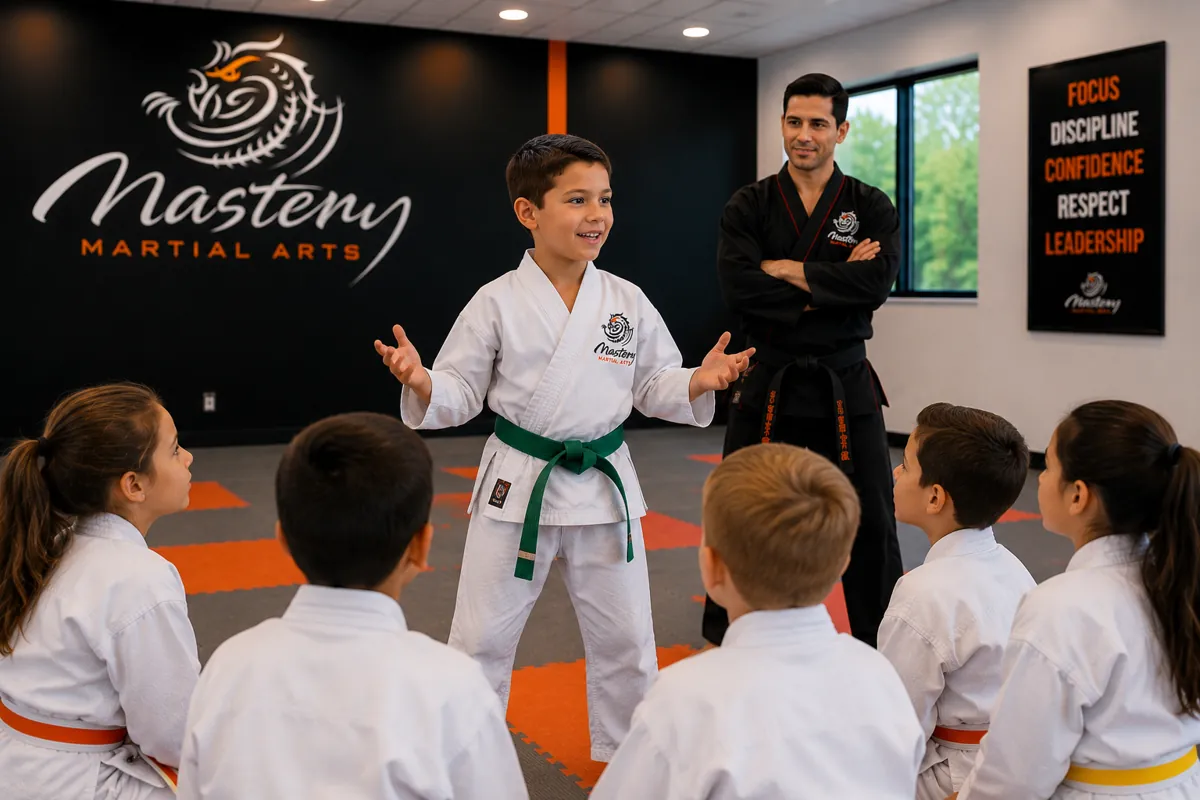
Ages 7–9 Program
The Confidence They Build Here Changes Everything.
Children ages 7–9 are learning how to see themselves.
Mastery Martial Arts™ helps them build confidence, focus, discipline, leadership, and resilience through structured martial arts training that carries into school, friendships, sports, and life.

Ready to see a class in action?
Click for Schedule & PricingConfidence is coached
Most children do not become confident because someone tells them they are confident. Confidence grows when they are challenged, supported, corrected, encouraged, and shown that they are capable of more than they thought.
That is why instructor connection matters so much. Children ages 7–9 still need adults who can see what they are capable of before they can fully see it themselves. The right instructor knows how to challenge a child without crushing them, how to praise effort without making success feel cheap, and how to create small wins that become real self-belief.
At Mastery Martial Arts™, confidence is built through coaching, structure, repetition, and progress. Children are not just told to believe in themselves. They are given experiences that make belief possible.
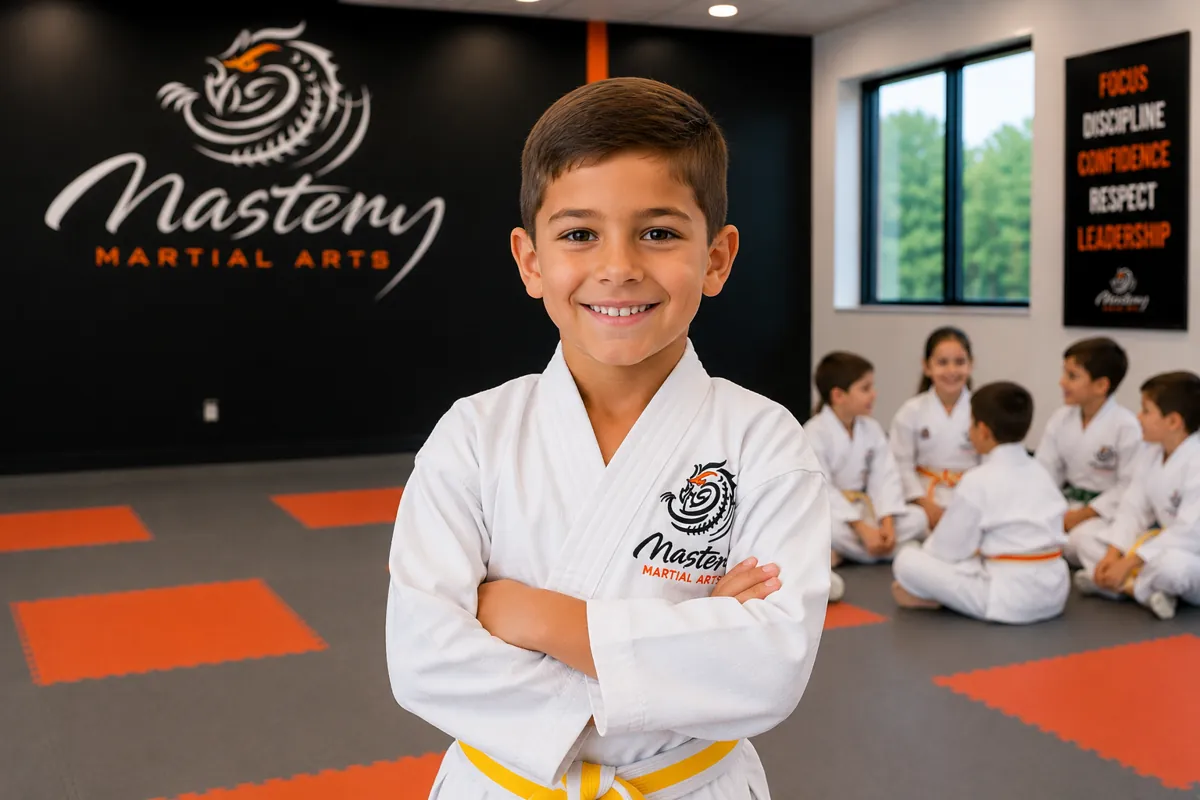
Confidence Development
Confidence at ages 7–9 is no longer something a child borrows from a parent or teacher. It is starting to become personal. Children in this window are forming their first real opinions about who they are, what they are good at, and whether they believe in themselves under pressure. That is why confidence classes for kids matter so much during this stage — the story a child tells themselves now can echo for years.
Self-esteem activities at this age work best when they involve real challenge and real recovery. A child does not build durable self-esteem from being told they are amazing. They build it from doing something difficult, struggling, getting coached through it, and seeing themselves improve. Mastery Martial Arts™ structures class around exactly that loop — challenge, coaching, recovery, progress, and recognition.
Confidence development for children also shapes identity. When a 7, 8, or 9 year old repeatedly experiences themselves as someone who keeps going, tries again, and earns progress, they start to believe that about themselves on purpose. That belief becomes the lens they use to walk into school, sports, social situations, and new experiences — long after class ends.
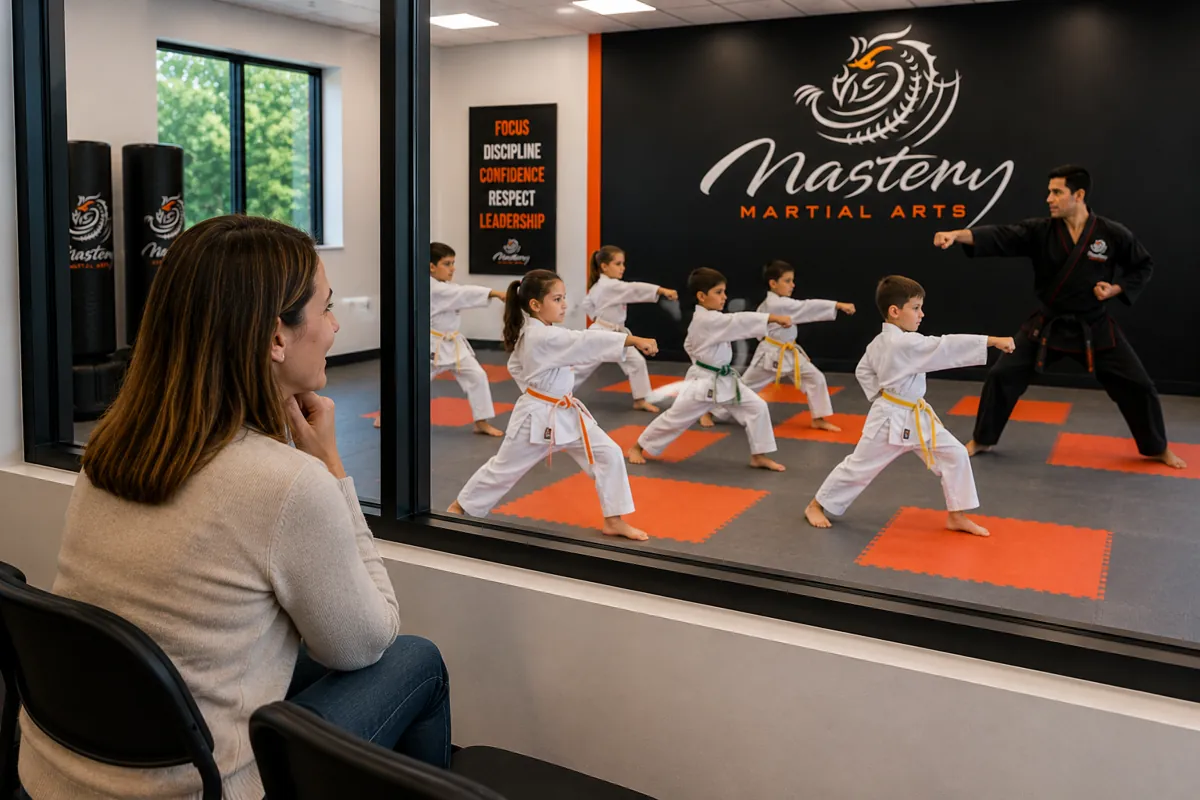
Focus And Academic Success
Focus classes for kids ages 7–9 are not about telling children to pay attention. Attention is built through structured repetition. School demands more focus every year at this stage — longer instructions, multi-step tasks, more independent work, and faster transitions. The children who thrive are the ones who have practiced concentration in an active, engaging environment.
Attention development happens best when focus is paired with movement and immediate feedback. In martial arts, a child has to listen, watch, respond, and adjust within seconds. That cycle repeats every class. The brain learns to lock on quickly, hold a thought, and act on it — which is the same skill set children use during reading, math, listening to a teacher, and finishing homework.
Concentration activities like these also strengthen follow-through. A child who learns to finish a sequence in class is more likely to finish a worksheet at home. A child who learns to reset after a mistake on the mat is more likely to recover after a tough question in class. Parents searching for ways to support school performance often discover that martial arts trains the underlying habits academics depend on.
Friendship And Social Confidence
Social skills for kids become more nuanced at ages 7–9. Children become more aware of belonging, comparison, fairness, and how they show up around peers. Friendship development takes on more weight because children are starting to choose their friends and notice who they feel comfortable around. For shy or cautious children, that awareness can feel heavy.
Confidence around peers is built through repeated, low-stakes social experiences. Martial arts class is full of them — greeting an instructor, partnering with a classmate, helping a newer student, encouraging effort, and recovering after a missed move. Each of those tiny social actions strengthens the child's ability to engage without freezing up.
Communication also grows in this window. Children practice speaking clearly, listening fully, and responding respectfully. Over time, they begin carrying that same social posture into the lunchroom, the playground, and the classroom. Many parents notice their child becoming more willing to join a group, introduce themselves, or speak up after a few months of consistent training.
Anti-Bullying And Self-Protection
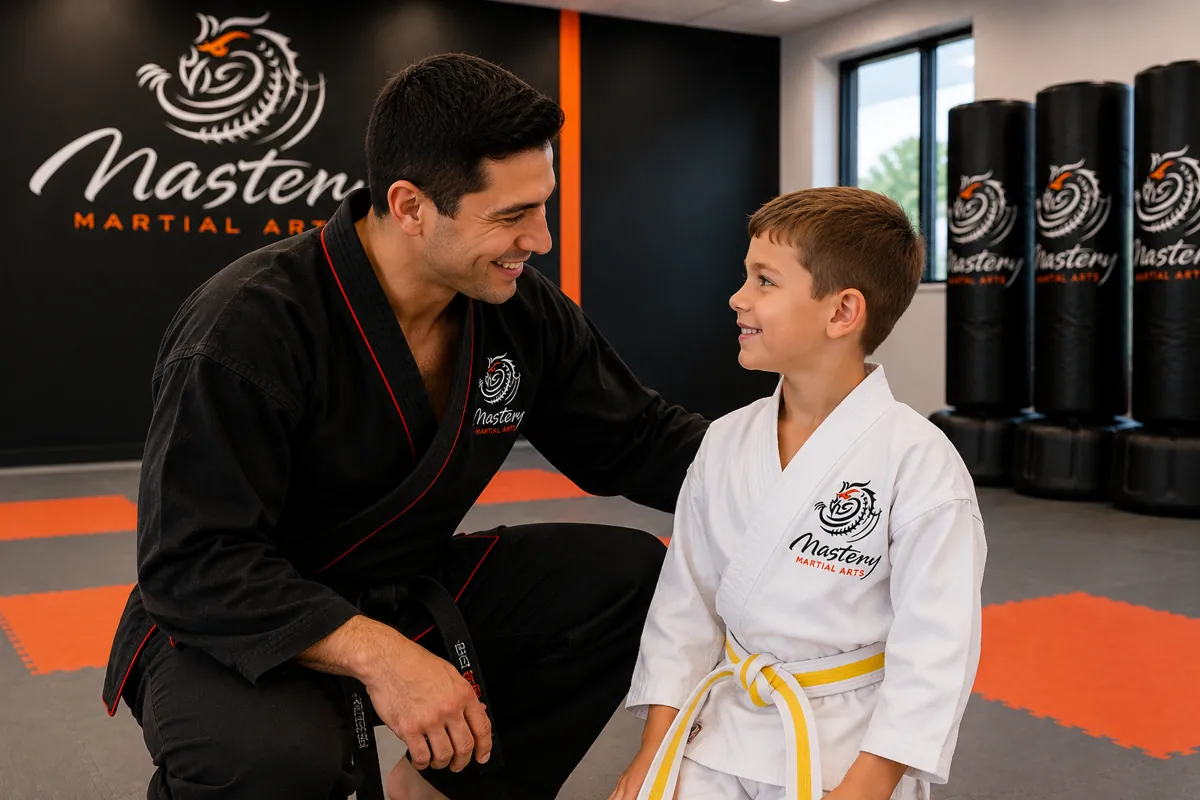
Anti bullying programs work best when they focus less on physical confrontation and more on confidence, posture, voice, and awareness. Most bullying targets the children who look unsure of themselves — quiet voices, low eye contact, hesitant body language. Building confidence against bullying starts with changing how a child carries themselves long before any incident happens.
Self defense for kids at Mastery Martial Arts™ is taught with strong emphasis on de-escalation, verbal confidence, and personal boundaries. Children learn how to use their voice, set a clear no, walk away with composure, and recognize situations early. The goal is not to teach a child to fight. The goal is to make sure they never feel like an easy target — and to give them tools if they ever truly need them.
Confidence under pressure is the deeper outcome. A child who has been coached through hundreds of small, manageable challenges in class is far less likely to freeze in a tough social moment. They have practiced standing tall, speaking clearly, and recovering quickly. That posture often does more to prevent bullying than any physical technique ever could.
Resilience And Mental Toughness
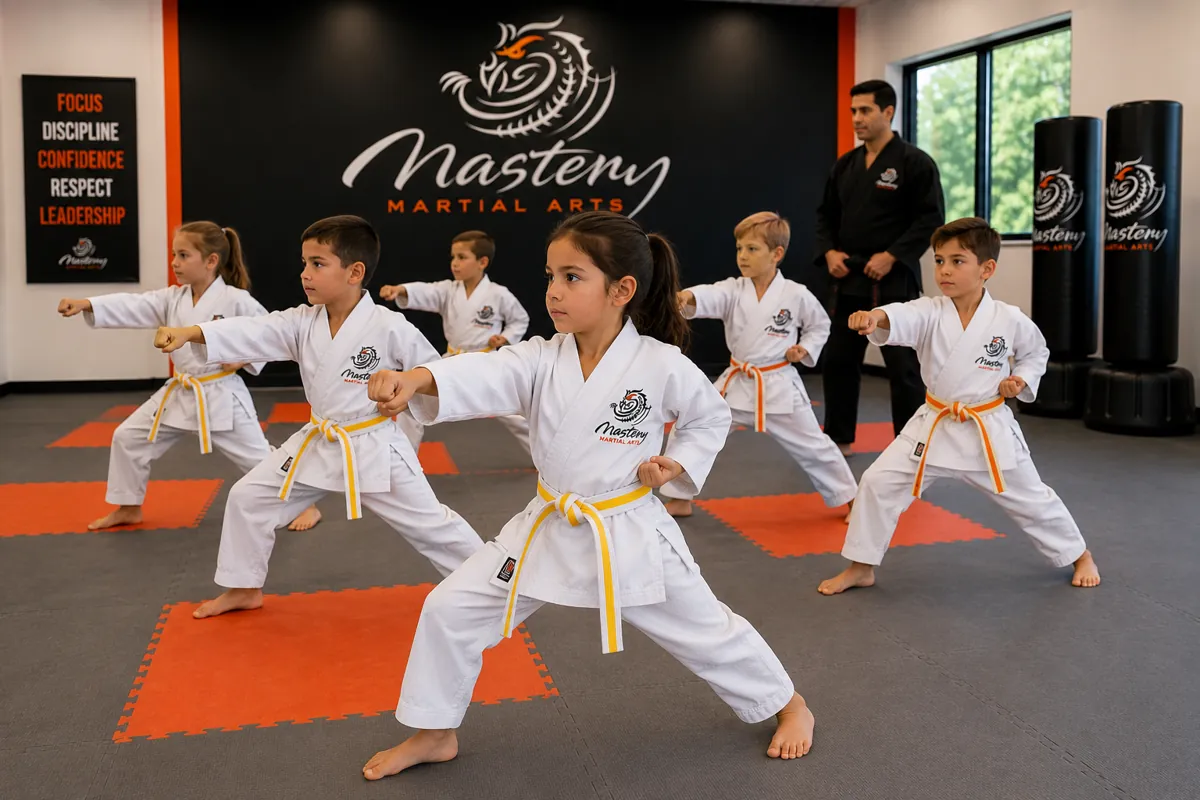
Resilience for kids is one of the most valuable long-term outcomes of an age-appropriate martial arts program. At ages 7–9, children begin remembering disappointment more personally. They replay failure. They can start avoiding things that feel exposing. Without coaching, that pattern hardens into the kind of child who quits early or only tries what they already know they can succeed at.
Growth mindset activities at this age work because children are old enough to understand improvement but young enough to fully adopt it. Class becomes living proof. A child who could not hold a stance last month can now. A child who froze in front of a group can now respond with confidence. That visible evidence rewires how they interpret challenge — from threat to opportunity.
Mental toughness for children is not about being hard. It is about being steady. It is the child who keeps trying after a missed move, stays composed after a correction, and finishes what they started even when it gets uncomfortable. Mastery Martial Arts™ trains that steadiness on purpose, one repetition at a time, until perseverance becomes part of who the child is.
Leadership Development
Leadership classes for kids ages 7–9 are not about turning a child into a boss. They are about planting the habits future leaders rely on — responsibility, accountability, clear communication, and the willingness to set an example. Those habits do not appear later by accident. They are trained, and this is one of the best windows to begin.
Child leadership training inside a Mastery Martial Arts™ classroom looks like small, repeatable moments. A child helps line up. A child encourages a classmate. A child remembers what comes next without being reminded. A child apologizes when they make a mistake. Each of those moments quietly tells the child, you are capable of leading yourself — and sometimes others.
Leadership development at this age also teaches that leadership is service, not status. The students who carry themselves well are the ones who help, include, try, and recover well. Over time, children begin to notice that role-modeling feels good. They want to show up well. That motivation becomes the foundation of everything from classroom leadership in elementary school to leadership eligibility in later years at Mastery Martial Arts™.
Curious what your child will experience?
See Schedule & PricingClass structure
Class starts with movement, energy release, and immediate structure so children can settle their bodies, focus their attention, and transition into learning mode.
Students practice age-appropriate martial arts technique, coordination, stance work, and body control while learning to stay coachable and persistent.
Children work with others to build timing, distance, cooperation, respect, and the ability to stay composed while learning alongside peers.
Instructors connect the physical lesson to life skills like attitude, speaking clearly, helping others, responsibility, and making strong choices under pressure.
Progress is noticed out loud so children leave feeling successful, seen, and motivated to come back and keep growing.
Recognition matters
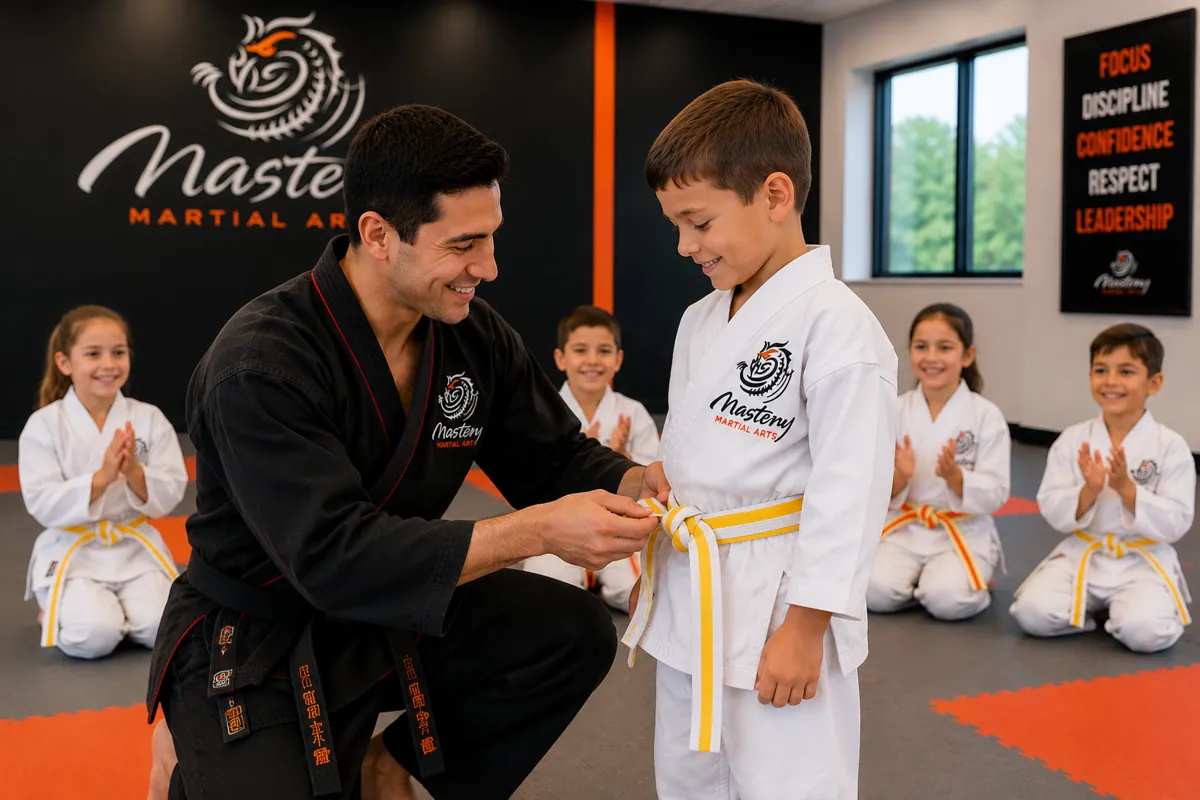
Children ages 7–9 need visible proof that effort leads somewhere. That is why stripes, belts, recognition, and progress markers matter so much. They are not just rewards. They are evidence.
When a child works hard, stays consistent, remembers a lesson, or handles a challenge better than they did before, recognition helps them connect that effort to identity. They start to think, I'm the kind of person who keeps going. I'm getting stronger. I can improve.
Over time, those small wins become a bigger story about who they are. That is how confidence stops being something fragile and starts becoming something earned.
Want pricing and class times?
Click for Schedule & PricingThe first 60 days
The first changes often show up outside the dojo.
Parents notice their child standing taller, trying new things, and carrying themselves with a self-belief that wasn't there before.
Quieter children become more willing to answer questions, ask for help, and use their voice at home, in class, and with friends.
Instead of melting down or shutting off, children begin pausing, resetting, and trying again — a habit that transfers everywhere.
Following directions becomes faster and more consistent because listening is practiced and reinforced every single class.
Children begin owning routines, remembering details, and connecting their own effort to the outcomes they experience.
Posture, eye contact, and presence shift. Parents often describe a child who suddenly looks and moves like someone who believes in themselves.
Why martial arts is different
Other Activities
Entertainment
Mastery Martial Arts™
Personal Development
Children are not just occupied. They are coached to grow in confidence, discipline, focus, and resilience.
Other Activities
Seasonal
Mastery Martial Arts™
Year-Round Growth
Progress continues all year, which gives children consistency during some of their most formative developmental years.
Other Activities
Participation
Mastery Martial Arts™
Leadership Development
Students learn how to speak up, set an example, help others, and carry themselves with greater maturity.
Other Activities
Bench Time
Mastery Martial Arts™
Active Participation
Every child is engaged. They are moving, learning, responding, and being coached throughout class.
Other Activities
Skill Building
Mastery Martial Arts™
Character Building
Technique matters, but so does how a child handles pressure, mistakes, effort, and responsibility.
Ready to book your free intro lesson?
See Schedule & PricingThe right fit
The program is designed around how children ages 7–9 actually learn, grow, and gain confidence.
Shy children often benefit most. Class builds confidence through small, repeatable wins instead of pressure or forced performance.
Quiet children practice using their voice in a supportive environment, so speaking up becomes a habit rather than a hurdle.
Confidence is built through earned success. Class provides a steady stream of small wins that compound into real self-belief.
Focus is trained through movement, cues, and short attention bursts that strengthen listening and impulse control.
Children practice trying again after mistakes, which gradually rewires how they respond to challenge in school and at home.
Posture, voice, eye contact, and verbal confidence are coached every class — the real foundation of anti-bullying readiness.
High-energy children get a productive outlet plus structure, learning how to channel intensity into focus and follow-through.
Instructors model respect, discipline, and encouragement — and children begin to mirror that behavior in their own lives.
What parents usually want help with
For children who doubt themselves, hesitate socially, or need more belief in what they are capable of.
For children who lose attention quickly, rush through directions, or need help staying present and following through.
For families working on first-time listening, smoother transitions, and stronger follow-through at home and school.
For children who get frustrated fast, shut down under pressure, or need better self-control when things feel hard.
For children learning to own their effort, take pride in progress, and carry themselves with more maturity.
For children ready to speak up, encourage others, set an example, and grow into a stronger sense of identity.
Because confidence is easier to build early than rebuild later.
Have questions? Start with a free visit.
Click for Schedule & PricingReal parent reviews
Families across our communities keep saying the same things: stronger confidence, better focus, better behavior, and children who believe in themselves more.
Kimmie Barnes
Barrington, RI
My daughter started very shy and scared. After working with their amazing teachers, she speaks clearly and confidently, has great self-esteem, and even talks about having a growth mindset.
Bryan Williams
Coventry, RI
Our son's confidence, focus, and excitement to learn have all grown so much under his instructor's guidance. We're really grateful for the impact he's had.
Aaron Vieira
Barrington, RI
Over the past year, our son has grown tremendously in confidence, focus, and discipline, and the impact has carried over into school and other parts of his life.
Casey McCaughey
Coventry, RI
My friends, family, and her teacher have seen a huge difference in her confidence, self-control, and emotional regulation in just 10 weeks.
Maria Saracen
Warwick, RI
Our child has grown in confidence and responsibility, and we are so thrilled with his enduring enthusiasm and commitment.
Matthew Santos
Johnston, RI
Since joining, our son has definitely improved at school and at home with regard to focus and self-control. I couldn't recommend Mastery enough.
Jennifer Poirier
Smithfield, RI
Before he was shy, hesitant, and didn't have a whole lot of confidence. Now he speaks up, stands out, and walks and speaks with confidence.
Sarah Sisson Andrews
Barrington, RI
The growth we've seen in confidence, self-esteem, focus, and physical skills has been remarkable. We couldn't be happier with our experience.
Final step
Every confident child starts somewhere.
Every leader starts somewhere.
Every black belt starts somewhere.
No Pressure.
No Experience Needed.
Just One Visit To See If Your Child Loves It.
See how it fits your family.
See Schedule & PricingWhy ages 7–9 matter
Ages 7–9 are some of the most important years in a child’s development because this is often when confidence stops being random and starts becoming personal. Children in this age range are no longer simply reacting to the world around them. They are beginning to form opinions about who they are, what they are good at, how they handle pressure, and whether they believe in themselves when things get hard. That matters more than many parents realize because the story a child starts telling themselves at this age can follow them for years.
This is the stage where self-belief begins to take shape in a more serious way. A child who repeatedly feels unsure, behind, left out, or easily discouraged can start to quietly believe that struggle means they are not capable. A child who is coached through challenges, recognized for effort, and shown how to keep going can begin building a very different internal belief: I can learn this. I can do hard things. I can improve. That shift affects far more than one activity. It changes how a child walks into school, speaks to adults, responds to mistakes, and handles social situations with other children.
School becomes more emotionally demanding during these years. Expectations go up. Children are asked to focus longer, listen more carefully, work independently, and bounce back faster when they do not understand something right away. At the same time, they are becoming more aware of comparison. They notice who raises their hand first, who seems naturally good at things, who gets picked, who gets praised, and who feels confident in a room. For some children, that awareness becomes fuel. For others, it becomes insecurity. That is why confidence at ages 7–9 cannot be left to chance.
Friendships also start to matter in a deeper way. Children become more sensitive to belonging, inclusion, embarrassment, rejection, and social status. A child who does not yet trust their own voice can begin holding back. A child who gets frustrated easily may struggle to navigate small conflicts. A child who doubts themselves can become overly dependent on reassurance from parents, teachers, or peers. That does not mean anything is wrong with them. It means they are in a developmental window where identity is forming and confidence needs coaching.
Emotional resilience is another major theme during this age range. Younger children often melt down and then recover quickly. Children ages 7–9 may begin carrying disappointment more personally. They remember what felt embarrassing. They replay failure. They can start avoiding things that make them feel exposed. Without the right support, that can look like quitting early, saying “I can’t,” shutting down, or only wanting to do things they already know they can succeed at. The answer is not constant praise without challenge. The answer is healthy challenge with strong support.
Responsibility also starts maturing here. This is the age when children can begin owning routines, remembering details, carrying themselves with more maturity, and seeing that their effort affects outcomes. When parents say they want their child to be more disciplined, more focused, or more responsible, they are usually describing a child who needs repeated opportunities to practice those habits in a structured and encouraging environment. That is why the right extracurricular activity matters so much. It should not only keep a child busy. It should help shape who they are becoming.
Growth mindset is especially powerful during these years because children are old enough to understand improvement but young enough to fully internalize it. When a child learns that effort matters, mistakes are part of progress, and confidence is earned through practice, that belief system can influence everything from homework and sports to social confidence and emotional regulation. Instead of seeing challenge as proof they are not good enough, they begin to experience challenge as part of how they grow.
This is also the age when identity becomes surprisingly important. Children begin to ask, consciously or not, What kind of kid am I? Am I confident or shy? Am I strong or weak? Am I a leader or someone who follows? Do I keep going or give up? Do I speak up or stay quiet? Those answers are not fixed. They are shaped by repeated experience. When a child regularly experiences progress, encouragement, accountability, and visible wins, they begin building an identity around strength, capability, and effort.
That is why ages 7–9 matter so much. This stage is not only about activity choice. It is about giving children the right environment at the exact time their confidence, self-image, responsibility, resilience, and leadership habits are still highly trainable. Parents often feel the stakes intuitively even if they cannot fully name them. They know their child is growing quickly. They know these years matter. And they know they want to help their child become someone who believes in themselves, handles challenges well, and steps into life with more certainty. That is exactly why this age group deserves more than a generic activity. They deserve coaching that helps shape the person they are becoming.
Frequently asked questions
Ready to see a class in action?
Click for Schedule & PricingLocations
615 Greenwich Ave, Warwick, RI 02886
1026 Tiogue Ave, Coventry, RI 02816
1386 Atwood Ave Unit #4, Johnston, RI 02919
Apple Valley Mall, 445 Putnam Pike, Smithfield, RI 02917
517 Main St, East Greenwich, RI 02818
1725 Mendon Rd, Cumberland, RI 02864
286 Maple Ave Suite 5, Barrington, RI 02806
429 S Washington St #2, North Attleborough, MA 02760
Local relevance
Localized programs serving families across Rhode Island and Massachusetts.
Kids Martial Arts · Warwick
Kids Martial Arts in Warwick gives families across Warwick, Cranston, West Warwick, and East Greenwich a trusted home for confidence, focus, leadership, and resilience for children ages 7–9. Classes are built around real coaching, character development, and visible progress — not entertainment. Parents searching for martial arts for ages 7–9 in the Warwick area will find a structured environment where shy children grow without pressure, high-energy children are given productive structure, and every child is coached toward earned confidence.
Visit Warwick Location PageKids Martial Arts · Coventry
Kids Martial Arts in Coventry serves families across Coventry, West Warwick, West Greenwich, and Foster who want a meaningful way to build confidence, focus, leadership, and resilience in their child at ages 7–9. The program emphasizes character development, accountability, and progress that children can see and feel. For Coventry-area parents searching for martial arts for ages 7–9, Mastery delivers warm coaching, strong standards, and a place where children grow into someone they are proud to be.
Visit Coventry Location PageKids Martial Arts · Johnston
Kids Martial Arts in Johnston gives families across Johnston, North Providence, Scituate, and Cranston a structured place for confidence, focus, leadership, and resilience at ages 7–9. Classes reinforce listening, follow-through, recovery from mistakes, and earned progress through coaching that meets each child where they are. For Johnston-area parents searching for martial arts for ages 7–9, the program meets shy children with patience and energetic children with structure.
Visit Johnston Location PageKids Martial Arts · Smithfield
Kids Martial Arts in Smithfield helps children ages 7–9 across Smithfield, Greenville, Lincoln, and North Providence build confidence, focus, leadership, and resilience in a structured, encouraging environment. Parents searching for martial arts for ages 7–9 near Smithfield often want more than activity — they want a place where their child learns to keep trying, speak up, and carry themselves with more maturity. Mastery is built around exactly that.
Visit Smithfield Location PageKids Martial Arts · East Greenwich
Kids Martial Arts in East Greenwich serves families across East Greenwich, Warwick, North Kingstown, and Exeter who are looking for a meaningful way to build confidence, focus, leadership, and resilience in their 7, 8, or 9 year old. The program emphasizes earned progress and character development — the habits children rely on every day at school, at home, and around peers.
Visit East Greenwich Location PageKids Martial Arts · Cumberland
Kids Martial Arts in Cumberland serves families across Cumberland, Lincoln, North Smithfield, and Woonsocket who want to build confidence, focus, leadership, and resilience in their 7, 8, or 9 year old. The program is designed around real character development and visible progress, not just movement. Cumberland-area parents will find a structured environment where every child is coached toward small wins and lasting self-belief.
Visit Cumberland Location PageKids Martial Arts · Barrington
Kids Martial Arts in Barrington helps children ages 7–9 across Barrington, Warren, Bristol, and Riverside build confidence, focus, leadership, and resilience through structured, age-appropriate training. Parents searching for martial arts for ages 7–9 near Barrington often want a place where shy children grow without pressure and where character is coached every class. Mastery delivers exactly that — with visible progress milestones that make children proud of what they earn.
Visit Barrington Location PageKids Martial Arts · North Attleboro
Kids Martial Arts in North Attleboro helps families across North Attleboro, Plainville, Attleboro, and Mansfield develop confidence, focus, leadership, and resilience at ages 7–9. Classes are built around coaching, accountability, and consistent progress — not pressure or competition. North Attleboro parents searching for martial arts for ages 7–9 will find a program where every child is met with strong standards and warm encouragement.
Visit North Attleboro Location PageCurious what your child will experience?
See Schedule & PricingHelpful resources
Deeper reading on the topics that matter most to families with children ages 7–9.
How children ages 7–9 build durable confidence through challenge, coaching, and earned progress.
Read MoreWhy focus is a trainable skill at this age and what actually strengthens attention at home and at school.
Read MoreHow posture, voice, eye contact, and self-control reduce the likelihood of being targeted.
Read MoreThe small habits that quietly form leadership identity in children ages 7–9.
Read MoreHow children learn to recover from mistakes and keep going when things feel hard.
Read MoreRespect, responsibility, perseverance, and the habits that shape who children become.
Read MorePopular Parent Searches
About Mastery Martial Arts™
For more than 33 years, Mastery Martial Arts™ has served families across Rhode Island and Massachusetts with one clear mission: helping children build confidence, focus, discipline, leadership, and resilience through martial arts training.
Parents trust Mastery because the goal has never been to run children through a generic activity. The goal is to help them become stronger mentally, emotionally, socially, and physically — while feeling seen, challenged, and supported every step of the way.
33+
Years Experience
RI • MA
Serving Rhode Island and Massachusetts
1,200+
Five-Star Reviews
Mission
Helping children build confidence, focus, discipline, leadership, and resilience through martial arts training.
1,200+ Five-Star Reviews
Verified by parents
Helping Children Build Confidence
Since 1992
8 Locations
Rhode Island & Massachusetts
Beginner Friendly
No experience required
Give your child the confidence, focus, leadership, and resilience that lasts a lifetime.